

Dental implants procedure
A step-by-step guide to exactly what happens and how long it takes
Most patients who are interested in dental implants have the same set of questions. How many appointments? How long does it take? What actually happens during the surgery? Will it hurt? And is there anything that might mean I am not suitable?
These are exactly the right questions to ask — and the frustrating thing is that online information about the dental implants procedure is often vague where it should be specific, or alarmist where the reality is considerably more straightforward.
This guide is written to fix that. It covers the full dental implant process in the order it actually happens — from the initial assessment through to the placement of the final crown and the long-term care that follows. At each stage, it explains what is happening clinically, why it is necessary, how long it takes, and what to expect in terms of discomfort and recovery.
At Wollaston Dental Practice on the High Street in Wollaston, Stourbridge, dental implants are led by Dr Mohammed Ihsan GDC No. 304200 — a Master’s graduate in Dentistry from the University of Szeged, a member of the Association of Dental Implantology, and a clinician currently pursuing a postgraduate diploma in oral surgery and implantology. The experience he brings to implant placement — including a background in emergency oral surgery across a wide range of complex cases — directly informs how each stage of the process is planned and executed.
What a dental implant actually is — before the procedure begins
It helps to understand what the procedure is building before following the stages of how it is built.
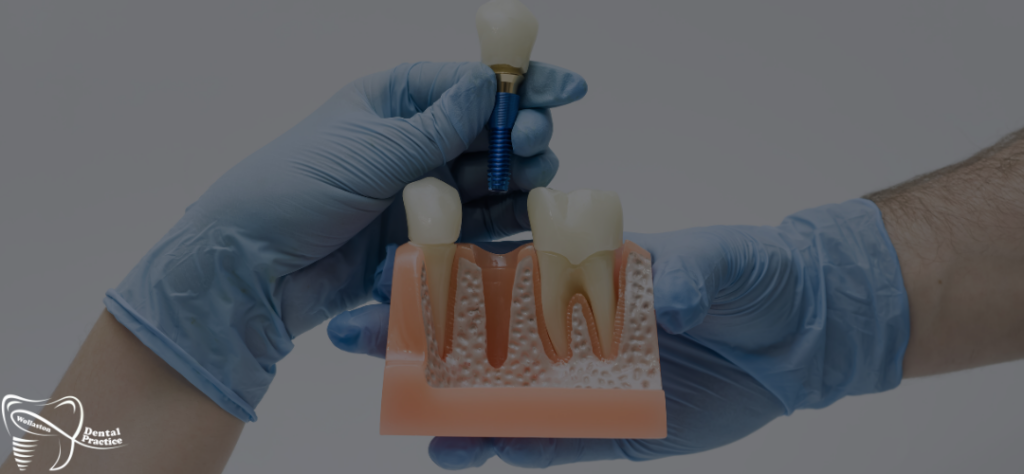
A dental implant is a titanium fixture — typically a small screw or post between 3.5 and 5mm in diameter and 8 to 16mm in length — that is placed surgically into the jawbone. Over the following weeks and months, the bone grows into and around the implant surface in a process called osseointegration, locking the fixture in place with a strength comparable to that of a natural tooth root.
Once osseointegration is complete, an abutment (connector piece) is attached to the implant, and a ceramic crown — matched in shape and colour to the surrounding teeth — is placed on top.
The result is a permanent, stable, independently functioning tooth replacement that looks, feels and functions like a natural tooth — and that, unlike dentures or bridges, actively preserves the bone in the jaw by transmitting biting forces into it in the way a natural root does.
This is the endpoint that the dental implant process is working toward at every stage.
Stage 1: the initial consultation and assessment
The dental implants procedure does not begin with surgery. It begins with a thorough assessment that establishes whether implants are clinically appropriate, what the bone and gum situation looks like, and what the full treatment plan involves.
At Wollaston Dental Practice, this consultation includes:
- Clinical examination The tooth or teeth being replaced, the adjacent teeth and the opposing teeth are all assessed. The gum tissue at the implant site is examined — its thickness, health and the width of attached gingiva are all clinically relevant to the implant plan. Any active gum disease or decay in adjacent teeth is identified and must be treated before implant placement proceeds.
- Radiographic assessment X-rays provide information about the bone height and density at the proposed implant site, the location of important anatomical structures (the inferior alveolar nerve in the lower jaw, the maxillary sinus in the upper jaw), and the root anatomy of any adjacent teeth. For more complex cases or where bone assessment needs to be more detailed, a CBCT (cone beam CT) scan provides a three-dimensional view of the bone that a flat X-ray cannot.
- Medical history review Certain medical conditions and medications affect implant suitability. Uncontrolled diabetes, bisphosphonate medications (used for osteoporosis), active chemotherapy, and smoking all influence the implant plan and success rates. Most medical conditions do not exclude implants entirely, but they affect how the treatment is planned and what precautions are taken.
- Treatment planning discussion Dr Ihsan will explain exactly what the treatment involves, in what sequence, and why. The number of appointments, the timeline from start to finish, any additional procedures needed (bone grafting, for example), and the full associated costs — available on our fees page — are all discussed before any decision is made.
Stage 2: preparatory treatment — getting the mouth implant-ready
For many patients, the implant placement appointment is not the next step after consultation. The mouth needs to be in the right condition first.
Addressing existing dental disease Active decay or gum disease must be treated before implants are placed. An implant placed into a mouth with active periodontitis is at significantly elevated risk of peri-implantitis — the implant equivalent of gum disease, which causes bone loss around the implant fixture and implant failure.
If root canal treatment is needed on adjacent teeth, or if gum disease requires a course of professional treatment with the dental hygienist, these appointments precede implant surgery.
Tooth extraction (if not already completed) Where the tooth being replaced has not yet been extracted, this is carried out first. In some cases — where the tooth is being removed specifically to be replaced with an implant and conditions are right — the implant can be placed at the same time as the extraction (immediate implant placement). Whether this is clinically appropriate depends on the condition of the bone, the absence of active infection, and the anatomy of the socket.
For cases where the tooth has already been extracted some time ago, the bone may have partially resorbed. If bone volume is insufficient to support a standard-diameter implant, a tooth extraction site that was left without immediate replacement may need augmentation before the implant can be placed.
Bone grafting (where required) Bone grafting is not always necessary — many patients have adequate bone for implant placement without it. Where it is required, bone grafting material (which may be synthetic, from animal sources processed to remove all proteins, or taken from another site) is placed at the implant site to increase bone volume. Grafting requires a healing period of three to six months before the bone is mature enough to receive an implant.
For patients who are concerned that bone loss from a long-standing gap may exclude them from implants, all-on-4 and all-on-6 solutions are specifically designed to work within reduced bone volumes using strategically angled implants — often avoiding the need for bone grafting even in patients with significant bone loss.
Stage 3: the implant placement procedure itself
This is the stage most patients are most apprehensive about — and usually the stage that surprises them most with how manageable it is.
The dental implants procedure for placement is carried out under local anaesthetic. The area is fully numb before anything begins. What you feel during the procedure is pressure, vibration and movement — but not pain. If at any point something feels sharp rather than like pressure, the procedure stops and additional anaesthetic is administered.
What happens:
A small incision is made in the gum over the implant site, and the gum is carefully reflected to expose the bone surface beneath. The implant site is then prepared using a sequence of precisely calibrated drills — beginning with a small pilot drill and progressing to the final diameter, which matches the implant being placed. Each drilling step is carried out slowly and with irrigation (cooled sterile saline) to prevent heat generation in the bone, which would affect healing.
The implant fixture is then placed into the prepared site using a controlled insertion technique that achieves the correct depth and angulation as planned. Where primary stability — the firmness of the implant in the bone at the time of placement — is achieved at the required level, this is a positive indicator for successful osseointegration.
The gum is then sutured over the implant site, and a healing cap or temporary prosthetic may be placed depending on the specific treatment plan.
How long does the placement take? For a single straightforward implant, the surgical appointment typically takes 30 to 60 minutes. Multiple implants placed in the same session take proportionally longer.
Immediate aftercare:
Some swelling and bruising for two to four days post-surgery is normal
Pain is typically mild to moderate and well controlled with ibuprofen and paracetamol for the first few days
A soft diet for the first week or two protects the healing site
Avoid smoking — smoking significantly impairs bone healing and substantially increases implant failure rates
Stage 4: osseointegration — the healing period
This stage is the longest part of the dental implant process and the one that requires the most patience.
Osseointegration — the biological fusion of the implant with the surrounding bone — takes three to six months, depending on the bone quality, the implant location, and the patient’s individual healing capacity. During this period, bone cells grow into the surface of the titanium implant (which is designed with a textured or micro-rough surface to encourage this) and the implant becomes progressively more firmly anchored.
During osseointegration, the implant is typically left undisturbed beneath the gum or with a minimal healing cap in place. The patient carries on with normal daily life — eating, speaking, working — though biting directly onto the implant site is avoided during this period.
At the end of the healing period, the implant is checked clinically and sometimes radiographically to confirm successful integration before proceeding to the next stage.
Stage 5: abutment placement
Once osseointegration is confirmed, the implant is uncovered (if it was submerged beneath the gum) and an abutment is attached. The abutment is the connector piece between the implant fixture below the gum and the crown above it. It is typically titanium or zirconia.
The abutment may be placed at a separate appointment from the crown, or the two may be combined. In some implant systems, the abutment and crown are designed and placed together as a single unit.
Following abutment placement, the gum tissue around it is allowed to mature into the correct shape — the gum margin needs to be in the right position to frame the crown naturally. This gum shaping period typically takes two to four weeks.
Stage 6: the final crown — the last step of the dental implants procedure
The crown — the visible tooth above the gum line — is designed to match the adjacent natural teeth in shape, size and colour. At Wollaston Dental Practice, impressions or digital scans are taken of the abutment and the surrounding teeth, which are sent to the dental laboratory where the crown is fabricated to the prescription.
Modern implant crowns are most commonly made from:
- Zirconia: Exceptionally strong, white ceramic that is ideal for posterior (back) teeth where biting forces are highest. Can be monolithic (single material throughout) or layered with a more translucent porcelain for better aesthetics in visible areas.
- Porcelain-fused-to-zirconia or metal: A ceramic outer layer bonded to a stronger substructure, combining aesthetics with structural integrity.
When the crown returns from the laboratory, it is fitted onto the abutment and checked for fit, appearance, and bite in all jaw positions. Once confirmed as correct, it is permanently secured.
From this point, the implant process is complete — and the tooth functions, appears and is cared for in essentially the same way as a natural tooth.
The all-on-4 process: when multiple teeth are being replaced
For patients who are missing all or most of their teeth — or whose remaining teeth are failing and extraction is the appropriate course — the all-on-4 or all-on-6 procedure uses the same biological principles as a single implant but applies them to full-arch reconstruction.
Four or six dental implants are placed per arch — often with two posterior implants angled to maximise engagement with available bone and avoid the need for bone grafting. A full fixed bridge is then secured to these implants, replacing a complete arch of teeth.
The all-on-4 dental implants procedure can often be completed in fewer overall appointments than individual implants for every missing tooth — and the strategic use of angled implants makes it possible for patients who have been told they lack sufficient bone for conventional implants.
The full restorative dentistry assessment at Wollaston Dental Practice evaluates which implant approach is most appropriate for each patient’s specific bone levels, bite, aesthetic goals, and overall oral health.
Looking after implants long-term
Implants do not decay — but peri-implantitis (bone loss around an implant driven by bacterial infection) is a genuine risk if the implant site is not kept clean. The principles of long-term implant maintenance are:
- Daily cleaning: Implant crowns are cleaned like natural teeth — twice daily brushing. But the margin between the crown and the gum requires specific attention. Interdental brushes or floss (including implant-specific floss) should be used to clean beneath the crown margin where plaque accumulates.
- Regular dental hygienist appointments: Professional cleaning around implants uses titanium or plastic instruments rather than steel scalers, which could scratch the implant surface. The dental hygienist monitors the gum tissue around the implant at every appointment, identifying early changes that indicate developing peri-implantitis before bone loss becomes significant.
- Regular dental check-ups: Dental check-ups include X-ray assessment of bone levels around implants at appropriate intervals, and clinical assessment of the crown, abutment and gum health.
- Smoking cessation: If smoking was a factor at any point before or during treatment, stopping reduces the ongoing risk of peri-implantitis significantly.
With appropriate maintenance, a well-placed dental implant routinely functions for 15 to 20 years and often for a lifetime. The crown on top may need replacement after ten to fifteen years — as any ceramic restoration does — but the fixture beneath can remain in service indefinitely.
The bottom line
The dental implants process is longer than some patients initially expect — typically six to twelve months from first consultation to final crown, with some cases taking longer where bone grafting is required. But the duration reflects a biological reality: osseointegration cannot be rushed, and the permanence of the result depends on allowing the bone to integrate fully before loading the implant.
What the dental implant process produces at the end of that timeline is a tooth replacement that is functionally superior to every other option available — stable, bone-preserving, natural in appearance and sensation, and designed to last.
At Wollaston Dental Practice in Stourbridge, Dr Mohammed Ihsan GDC No. 304200 leads every dental implant case with the clinical precision, surgical experience and patient-centred communication that this level of treatment demands. Whether you are replacing a single tooth, considering all-on-4 or all-on-6, or exploring your full range of restorative options, the starting point is a consultation that gives you the complete picture before any commitment is made.
Call us on 01384 438 143 or visit us at 27 High Street, Wollaston, Stourbridge, DY8 4NJ.
Disclaimer
The information in this article is intended for general educational guidance only and does not constitute personalised dental advice. Suitability for dental implants depends on individual clinical circumstances and should be assessed by a qualified dental professional.
Wollaston Dental Practice is a private dental practice at 27 High Street, Wollaston, Stourbridge, DY8 4NJ. Led by Dr Mohammed Ihsan GDC No. 304200 — Master’s in Dentistry, member of the Association of Dental Implantology. We offer dental implants, all-on-4 and all-on-6, restorative dentistry, tooth extractions, root canal treatment, dental check-ups, dental hygiene appointments, emergency dental care, Invisalign, composite bonding, porcelain veneers, teeth whitening, dental crowns, smile makeovers and facial aesthetics. Call 01384 438 143.
Frequently asked questions
How long does the full dental implant process take from start to finish?
For a straightforward single-tooth implant without bone grafting, the full dental implant process from initial consultation to the final crown typically takes five to nine months — the majority of which is the three to six month osseointegration period when no active treatment is taking place. Where bone grafting is needed before implant placement, the total timeline extends to nine to eighteen months. Cases involving multiple dental implants or all-on-4 reconstruction are planned individually at the consultation stage, and Dr Ihsan will give you an accurate timeline based on your specific clinical situation.
Does the dental implant placement procedure hurt?
The procedure is carried out under local anaesthetic — the area is fully numb throughout, and what you feel is pressure and vibration rather than pain. For the majority of patients, the experience is less uncomfortable than they anticipated. Following the procedure, mild to moderate soreness for two to four days is typical, managed well with ibuprofen and paracetamol. Significant pain beyond this period warrants a call to Wollaston Dental Practice for assessment.
What if I do not have enough bone for a dental implant?
Insufficient bone volume is one of the most common concerns in implant assessment, but it rarely rules implants out entirely. Bone grafting before implant placement can rebuild bone volume in most cases, allowing conventional implants once healing is complete. For patients with more significant bone loss — particularly those missing all or most of their teeth — all-on-4 and all-on-6 implant solutions are specifically designed to work within available bone using angled placement, often without grafting. The CBCT scan taken at the assessment stage gives the complete three-dimensional picture needed to plan accurately.
How do I look after my dental implants once the procedure is complete?
Daily brushing twice a day using a soft-bristled brush, cleaning around the implant margin with interdental brushes or implant-specific floss, and attending regular dental hygienist appointments for professional cleaning around the implant. Avoiding smoking and maintaining regular dental check-ups for radiographic monitoring of bone levels around the dental implant are equally important. With appropriate maintenance, implants routinely function for many decades.
How much does the dental implants procedure cost at Wollaston Dental Practice?
Full details of our treatment fees — including implant assessment, placement, abutment, crown, and any associated procedures — are available on our fees page. We present costs transparently so you have a clear picture before committing to any treatment. Finance options may also be available — call 01384 438 143 and the team will walk you through the costs and any payment plan options relevant to your case.